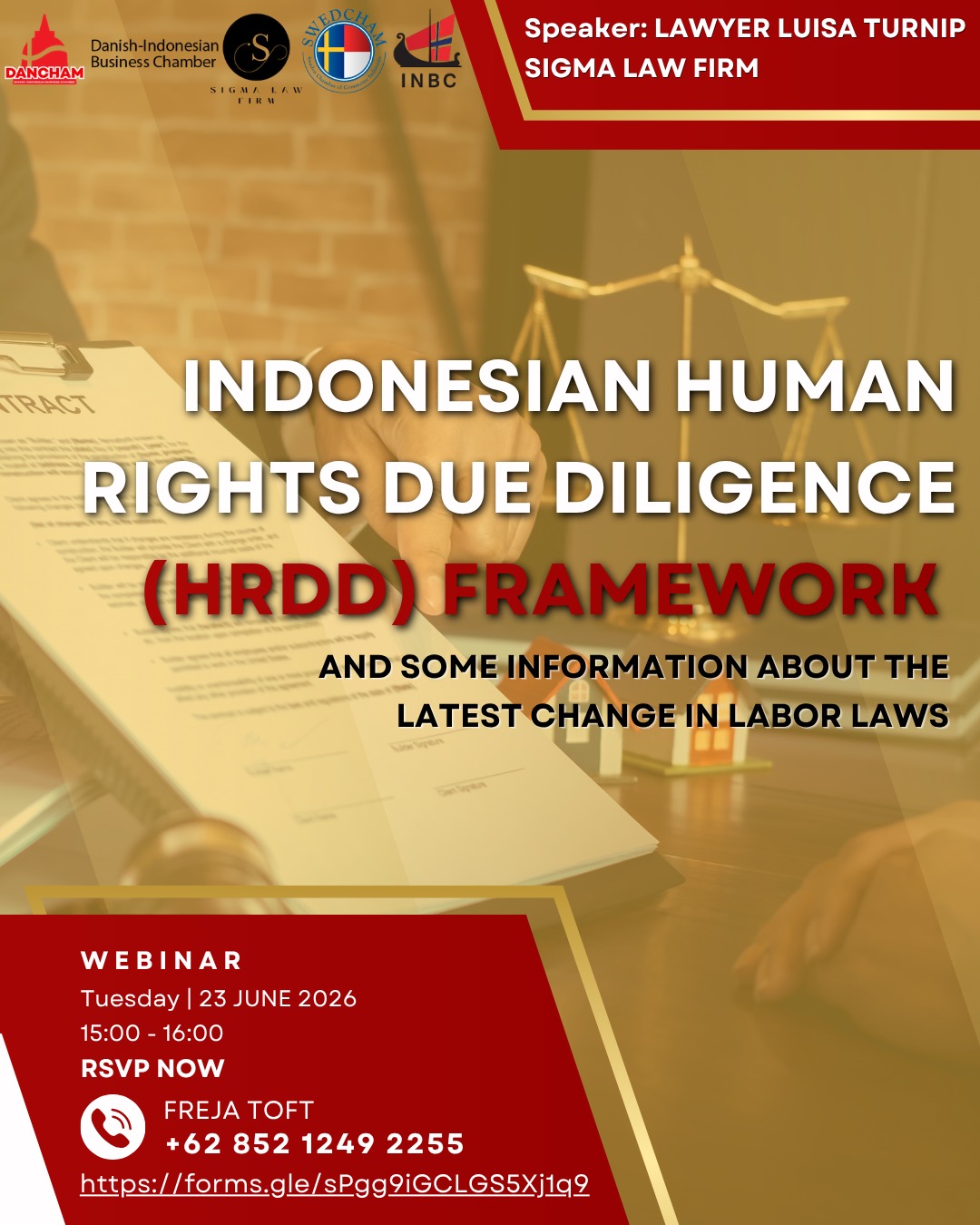
Webinar: Understanding Indonesia’s Legal System – Indonesian Human Rights Due Diligence and Labor Laws
Summary of the webinar presented by DanCham in cooperation with SwedCham and the INBC, delivered by Luisa Turnip, Sigma Law Firm, 23 June 2026
Human Rights Due Diligence (HRDD) is shifting from a voluntary sustainability practice to a condition of doing business, particularly for companies in international supply chains. For Swedish and Nordic exporters, the relevant point is no longer ethical positioning but market access: European regulation, investor expectations, and supply-chain transparency requirements increasingly make demonstrable HRDD a precondition for trade and investment.
The Indonesian framework is consolidating. Key instruments include Presidential Regulation 60/2023 on the National Strategy for Business and Human Rights, the National Action Plans and standards issued by Komnas HAM (most recently its 2024 norm on business and human rights), and OJK sustainability-reporting obligations for financial institutions and listed companies. According to the webinar, the direction of travel points toward a mandatory regime — extending HRDD obligations to companies with more than 2 000 employees, all exporting companies and their supply chains, and designated high-risk sectors by 2028 — replacing the self-assessment approach under Perpres 60/2023 and the Ministry’s PRISMA platform.
Scope extends beyond direct employees. HRDD covers suppliers, contractors, and environmental impact. Labour risks raised included child and forced labour, retention of identity documents, excessive overtime, wage deductions, discriminatory hiring, union suppression, and harassment. Environmental risks included water and air contamination, deforestation, community health impacts, and displacement of local and indigenous communities.
Internal systems. Companies are expected to maintain human rights and ethics policies, anti-discrimination and anti-harassment policies, whistleblowing and grievance mechanisms, codes of conduct, and risk-management and ESG reporting processes. HRDD is treated as cross-functional — HR, procurement, compliance, management, and board oversight — rather than the responsibility of a single department.
Employment compliance remains the baseline, including minimum wage, working-hours and overtime rules, BPJS Health and Employment, THR, leave entitlements, occupational health and safety (K3), and termination procedures.
2026 labour-law developments flagged in the webinar:
- Permenaker 7/2026 limits outsourcing to six categories: cleaning, catering, security, transport/drivers, supporting services, and certain support roles in mining, oil & gas, and electricity.
- The Domestic Workers Law (UU PPRT), passed 21 April 2026, sets working hours, health insurance, and legal protections for household workers.
- Labour Law 13/2003 is under revision, covering wages, employment relations, termination, and severance.
- The National Safe Migrant Movement (launched 18 May 2026) targets illegal recruitment and trafficking.
For members: Companies already familiar with EU sustainability rules will recognise the underlying principles; the work in Indonesia is local adaptation, documentation, and supply-chain oversight. Treated as a business capability rather than a compliance exercise, HRDD supports market access, investment attractiveness, and operational resilience.
Download the presentation