Indonesian Halal Regulations and Implementation: Opportunities and Challenges for Foreign Investors
KADIN Morning Group Discussion — Jakarta, 1 July 2026
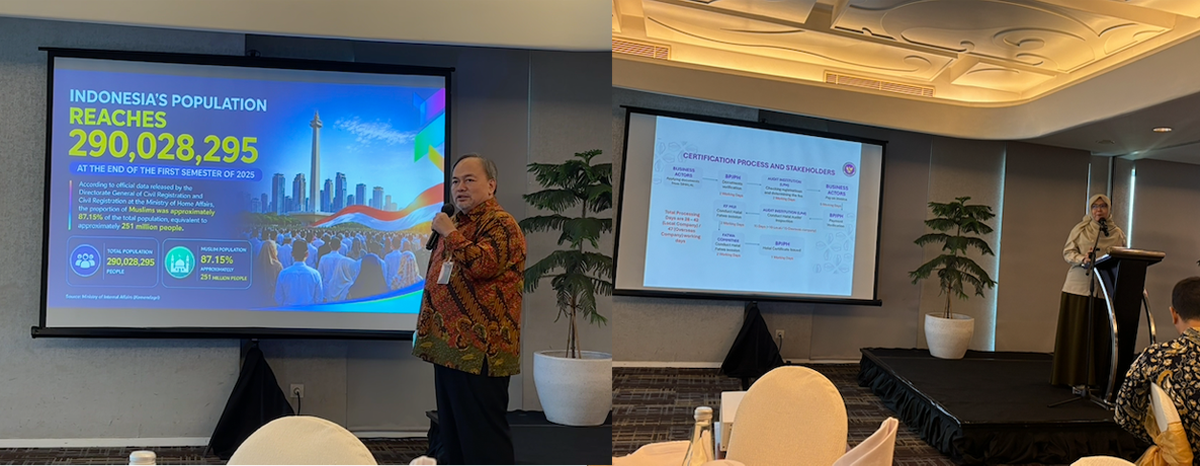
SwedCham Indonesia participated in a morning group discussion on Indonesian halal regulations hosted by the Indonesian Chamber of Commerce and Industry (KADIN) on 1 July 2026 at the JS Luwansa Hotel & Convention Center in Jakarta. The meeting, convened by Mr. Emmanuel L. Wanandi, KADIN Vice Chairman for Foreign Chambers Partnership, gathered representatives of some forty foreign chambers of commerce and business councils. It was the second in a series of biannual briefings through which KADIN bridges the foreign chamber community and Indonesian government institutions; the first addressed investment policy.
The speakers were Dr. Fariza Irawadi, Expert Staff for Public Relations at the Halal Product Assurance Organizing Agency (BPJPH), and Mrs. Yanis Naidi, BPJPH Director of Halal Certification. BPJPH Head Mr. Ahmad Haikal Hasan, originally scheduled to speak, was unable to attend due to a state ceremony.
The October 2026 deadline
The central message of the meeting was the approaching enforcement date for mandatory halal certification. From 17 October 2026, imported products within the first mandatory categories — food, beverages, and related goods and services — must hold halal certification to enter Indonesia, with enforcement at customs. The obligation derives from Law No. 33 of 2014 on Halal Product Assurance, as amended by the Job Creation Law (No. 6 of 2023) and implemented through Government Regulation No. 42 of 2024. The requirement took effect for medium and large domestic producers in October 2024; small and micro enterprises and imported goods were deferred two years at the request of the foreign business community. BPJPH stated that no further extension will be granted.
The 2026 wave extends beyond food and beverages to traditional medicine and supplements, cosmetics, chemical products, goods from genetically modified organisms, and other goods made from animal-derivative materials — including clothing and accessories, cleaning agents, home appliances, praying equipment, office supplies, and Category A medical devices. Later phases cover over-the-counter drugs and Category B medical devices in 2029, and prescription drugs and Category C medical devices in 2034. Products that are intentionally non-halal, such as alcoholic beverages and pork products, are not banned; they must instead carry a non-halal label, at no fee. The labeling regulation is being finalized and is expected before October.
The market case
BPJPH framed the regulation as an opportunity as much as a compliance requirement. Indonesia’s population of approximately 290 million is about 87 percent Muslim, making it the largest halal market in the world. Figures presented at the meeting (Precedence Research, 2026) valued the global halal market at USD 3.6 trillion in 2026, forecast to reach USD 7.08 trillion by 2035. BPJPH now issues around 8,000 halal certificates per day, with some four million products certified by 2025. Indonesia’s rise to second place in the 2026 Global Muslim Travel Index was cited as evidence of momentum in halal tourism, and hotels and restaurants were encouraged to pursue certification — which does not preclude serving alcohol, provided operations are separated.
Two routes to certification
Foreign companies can obtain certification in two ways. The first is the Indonesian process: registration through the SiHalal online system, document verification, an audit by one of 129 accredited Halal Inspection Agencies (LPH), and a fatwa committee ruling — in total around 28 to 42 working days for domestic companies and up to 47 for overseas applicants, plus travel logistics for foreign site audits. Certificates issued through the Indonesian process carry lifetime validity as long as ingredients and processes remain unchanged. The second route relies on mutual recognition: certificates issued by foreign halal certification bodies holding an MRA with BPJPH need only be registered in Indonesia, at a fee of IDR 800 000 per certificate. Companies should verify that the foreign body’s accredited scope matches their product category.
Foreign applicants must appoint an importer or official representative in Indonesia, holding a business identification number (NIB), and designate a halal supervisor — a Muslim individual holding a training certificate from a BPJPH-listed institution and a BNSP-accredited competency certificate. All documentation is submitted online through SiHalal. Audits assess five criteria: management commitment, halal status of ingredients, separation of halal and non-halal production, product labeling, and internal monitoring by the halal supervisor. As a transitional simplification, ingredients lacking halal certificates may until mid-October 2026 be supported by alternative documentation such as process flowcharts and certificates of analysis.
Certification costs comprise an application service fee and the LPH audit fee, the latter varying with company scale, number of products and facilities, and auditor travel. A worked example presented at the meeting, covering 55 dairy products at a single facility, ranged from approximately IDR 2.2 million for a micro or small domestic enterprise to IDR 47.4 million for an overseas producer, the difference driven largely by auditor travel and accommodation. BPJPH provides a fee calculator and English-language guidance on its website, bpjph.halal.go.id.
Questions from the floor
The Q&A reflected practical concerns across the chamber community. A representative of a major footwear and apparel brand asked how the regulation will apply to non-food manufacturing and imported raw materials, noting the risk of adding friction at a time when Indonesia is competing for relocated investment; BPJPH clarified that non-food goods require certification only when made from animal-derivative materials. Questions on existing products already in the market and on the treatment of MRA-country goods were acknowledged as still under discussion. SwedCham raised the absence of EU-based certification bodies among BPJPH’s MRA partners, which currently obliges most European exporters to use the Indonesian process or third-country bodies. On reports that Indonesia might shorten certificate validity to one year, BPJPH confirmed the idea has been discussed but that no plan exists; any change would require legislative approval.
Follow-up
BPJPH invited the foreign chambers to a follow-up meeting at its offices before the October deadline, and the presentation materials will be circulated through KADIN to participating chambers. SwedCham will continue to monitor implementation and share updates with members.
Swedish companies exporting food, beverages, consumer goods, cosmetics, or health products to Indonesia are advised to assess their certification status well before 17 October 2026. SwedCham’s Halal Fact Sheet, available in the Reports & Publications section, provides a fuller overview of the regulatory framework, and the chamber can connect members with relevant specialists and authorities.
Download Meetings Presentation