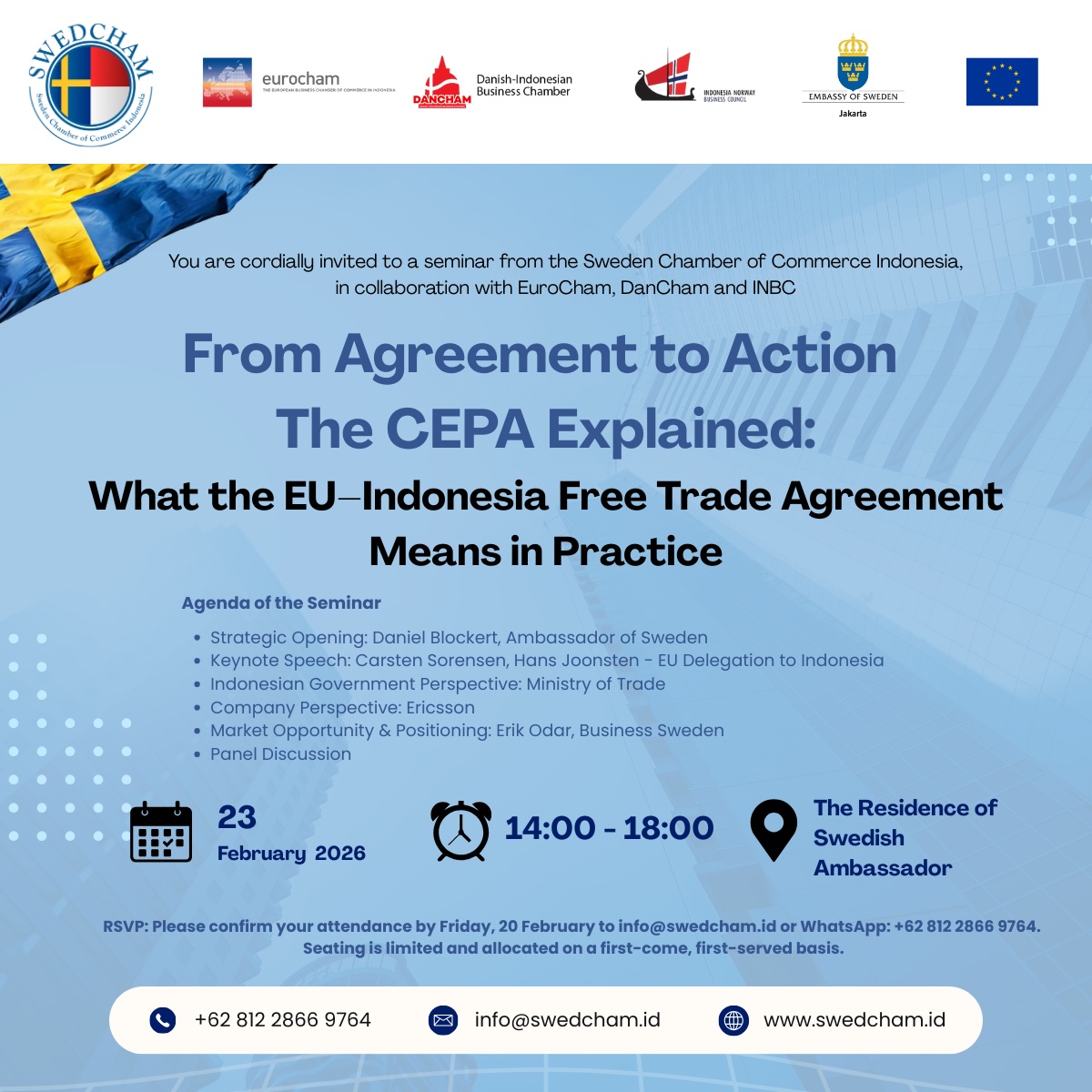
From Agreement to Action — The CEPA Explained
What the EU–Indonesia Free Trade Agreement Means in Practice
On 23 February 2026, SwedCham Indonesia hosted a seminar on the proposed EU–Indonesia Comprehensive Economic Partnership Agreement (CEPA) at the Residence of the Swedish Ambassador in Jakarta. It brought together government, industry, trade organizations, and the diplomatic community to examine the agreement’s strategic significance, its likely effect on trade and investment, and the practical challenges of putting it into operation.
Speakers included representatives of the Embassy of Sweden, the EU Delegation to Indonesia, and Indonesia’s Ministry of Trade, alongside participants from manufacturing, logistics, technology, legal services, and finance. One distinction framed the day: a trade agreement is concluded at signature, but its value is realized — or lost — in implementation.
Negotiations on the agreement were concluded in 2025, and CEPA has since been signed; it now moves to ratification by the European Parliament and the Indonesian Parliament. Entry into force is targeted for early 2027 — timed to take effect before Indonesia’s preferential access under the EU’s Generalised Scheme of Preferences (GSP) expires, which would otherwise raise tariffs on a range of Indonesian exports.
About the seminar
The seminar was hosted by SwedCham Indonesia in collaboration with EuroCham, DanCham, and the Indonesia–Norway Business Council (INBC), and supported by the Embassy of Sweden, the EU Delegation to Indonesia, Ericsson, and Business Sweden. The half-day program combined keynote policy insights, implementation perspectives, and a business panel, followed by a moderated discussion and question-and-answer session.
Program
- CEPA in the context of Sweden–Indonesia and EU–Indonesia relations — Daniel Blockert, Ambassador of Sweden
- Keynote: EU–Indonesia CEPA — strategic intent and timeline — Carsten Sorensen and Hans Joostens, EU Delegation to Indonesia
- The Indonesian government perspective — Johni Martha, Senior Advisor to the Minister of Trade for International Relations
- Company perspective: what CEPA may change on the ground — Ronni Nurmal, Vice President, Ericsson Indonesia
- Market opportunity and positioning — Erik Odar, Business Sweden
- European industry engagement — Edison Bako, Executive Director, EuroCham
Why CEPA matters
The European Union and Indonesia are large markets with complementary economies, but trade between them has long been constrained by tariffs, divergent standards, and administrative friction. CEPA is intended to reduce that friction across goods, services, investment, and regulatory cooperation. For European exporters, the agreement is expected to lower duties and simplify procedures; the European Commission has estimated annual duty savings for EU exporters in the region of EUR 600 million once it is in force.
For Swedish and other Nordic companies, CEPA is more than a tariff schedule. Many already hold long-term operations, supply chains, or market-entry plans in Indonesia, and for them the agreement functions as a strategic framework that will shape competitiveness, compliance, and investment decisions over the coming decade. The central question of the seminar was not whether the agreement is significant — both sides agreed that it is — but whether the institutions on each side are prepared to make it work in practice.
Implementation is the real challenge
The Swedish Ambassador described CEPA as among the most ambitious trade agreements Indonesia has negotiated, and was direct about where the work now lies: in the years of implementation ahead. Business organizations — EuroCham Indonesia and the bilateral chambers among them — were identified as having a practical role: surfacing the frictions companies actually encounter and feeding them back into the dialogue between government and industry.
That emphasis reflects the structure of the Indonesian state. Authority over trade, customs, standards, and investment is distributed across national ministries, agencies, and provincial governments, and coordination between them is uneven. A commitment agreed in the text still has to travel through a decentralized administrative system before a company feels any change at the border or in a licensing queue. The gap between text and practice was the recurring concern of the day.
Greater regulatory predictability
A central promise of CEPA is predictability and legal certainty. The agreement aims to reduce tariffs on approximately 98 percent of tariff lines and to remove or simplify many non-tariff barriers. For most companies, EU representatives suggested, that predictability is worth more than any single tariff cut: knowing in advance how a shipment will be treated allows firms to plan, price, and commit.
Import licensing was the concrete example. Companies currently face uncertainty over the quantities they will be permitted to import, with limited visibility on timing. CEPA is intended to introduce clearer timelines and a “yes or no” mechanism, under which an application is automatically approved if the authorities do not respond within 30 days. On customs, Indonesian officials pointed to national single-window systems and digitalized procedures as the route to faster, more consistent clearance — while acknowledging this remains work in progress.
Technical barriers to trade
Beyond tariffs, technical barriers — standards, testing, and certification — often determine whether a product can realistically reach a market. The agreement encourages convergence toward international standards so that goods tested once need not be tested again on arrival. The automotive sector served as the illustration: EU representatives argued that repeated local crash-testing requirements add unnecessary cost to low-volume luxury imports, where re-testing a handful of vehicles is particularly uneconomic. Indonesia’s planned acceptance of a range of international automotive standards was presented as a meaningful step toward reducing such duplication. The example is specific to one sector, but the principle — recognize credible testing done elsewhere rather than repeat it — runs across many product categories.
Investment and services
CEPA also addresses services and investment. EU speakers described the agreement as seeking national treatment and non-discrimination for European companies in Indonesia — treatment no less favorable than that given to domestic firms. Two examples were highlighted. In telecommunications, full (100 percent) foreign ownership would become possible. And the rules governing the temporary movement of professional staff within multinational companies would be eased, making it simpler to move expertise into a local operation when it is needed. For service businesses in particular, the ability to operate, staff, and be paid without arbitrary friction can matter more than headline tariff lines.
Sustainability
Both EU and Indonesian representatives described CEPA as more advanced than Indonesia’s previous trade agreements in its treatment of sustainability, with commitments spanning labor standards, environmental protection, gender equality, and sustainable development. The Indonesian side framed these provisions less as a constraint than as a platform — a basis for cooperation on green technologies, carbon reduction, and environmental regulation. It is also among the most closely watched parts of the agreement internationally, and that cooperative framing should be read alongside the wider scrutiny.
The Indonesian government perspective
Representatives of the Ministry of Trade presented CEPA as a strategic response to growing global economic uncertainty. In their account, the agreement could help Indonesia strengthen domestic manufacturing, develop downstream industries, and shift its export profile toward higher-value-added products rather than raw materials. Forecasts presented at the meeting suggested it could materially increase Indonesian exports to the EU and contribute to GDP growth. The government’s interest, in other words, is not only in market access for European goods but in using the agreement to advance Indonesia’s own industrial ambitions — which helps explain both its enthusiasm for the deal and its caution on certain provisions.
Questions raised by participants
Questions from the floor — concentrated on the detail that will determine how the agreement is experienced. EU officials confirmed that detailed tariff schedules had not yet been published, despite earlier expectations, which makes precise planning difficult until the final text and annexes are available. Halal certification, speakers explained, sits outside CEPA itself, though EU–Indonesian discussions on it were continuing in parallel. Participants also pressed on import licensing and on local content requirements (TKDN) — governed by a separate body of Indonesian regulation — and asked how far, and how fast, the move toward international standards would reach.
Running through these questions was a single concern: overlapping rules and weak coordination between ministries. Indonesian officials acknowledged it directly and pointed to inter-agency data sharing and streamlined import administration as the intended remedies.
Key takeaways
- Whether CEPA delivers will depend on execution across Indonesia’s agencies, not on the signing. Both sides said so plainly.
- For most companies the headline gain is predictability rather than the tariff reductions themselves, which cover roughly 98 percent of tariff lines.
- Import-licensing reform — clearer timelines and automatic approval after 30 days — is among the most concrete, business-relevant changes on offer.
- Convergence toward international standards aims to cut duplicate testing, illustrated by the automotive crash-testing case.
- Services and investment provisions — national treatment, full foreign ownership in telecommunications, easier staff mobility — may matter as much as goods tariffs for many firms.
- Sustainability commitments go further than in Indonesia’s earlier agreements.
- For Jakarta, CEPA is also an instrument of industrial policy, not only market access.
- The frictions that remain are practical: inter-ministerial coordination, import permits, local content, and certification.
- Several technical details — tariff schedules in particular — were still pending at the time of the seminar.
- Continuous government–industry dialogue will decide whether the benefits are realized; chambers, including SwedCham, have a defined role in it.
The overall tone was cautiously optimistic. Both sides treated the agreement as a substantial opportunity to expand trade between two large markets, while accepting that bureaucratic reform and sustained dialogue — not the text alone — will decide the outcome.
Speakers
Daniel Blockert — Ambassador of Sweden. Set the agreement within the wider context of Sweden’s and the EU’s relations with Indonesia.
Carsten Sorensen and Hans Joostens — EU Delegation to Indonesia, the European Union’s diplomatic mission in Jakarta. Delivered the keynote on the agreement’s strategic intent and timeline.
Johni Martha — Senior Advisor to the Minister of Trade for International Relations, representing Indonesia’s Ministry of Trade.
Ronni Nurmal — Vice President, Ericsson Indonesia. Ericsson is a Swedish telecommunications company and a SwedCham member.
Erik Odar — Business Sweden, Sweden’s trade and investment promotion organization.
Edison Bako — Executive Director, EuroCham, the European Business Chamber of Commerce in Indonesia.
Mark Lempp — Business News Editor, The Jakarta Post. Moderated the discussion and question-and-answer session.
Download the full meeting report and presentations
A summary of the meeting is also available as a PDF: Download the complete meeting report (PDF).